

 +1-786-272-2672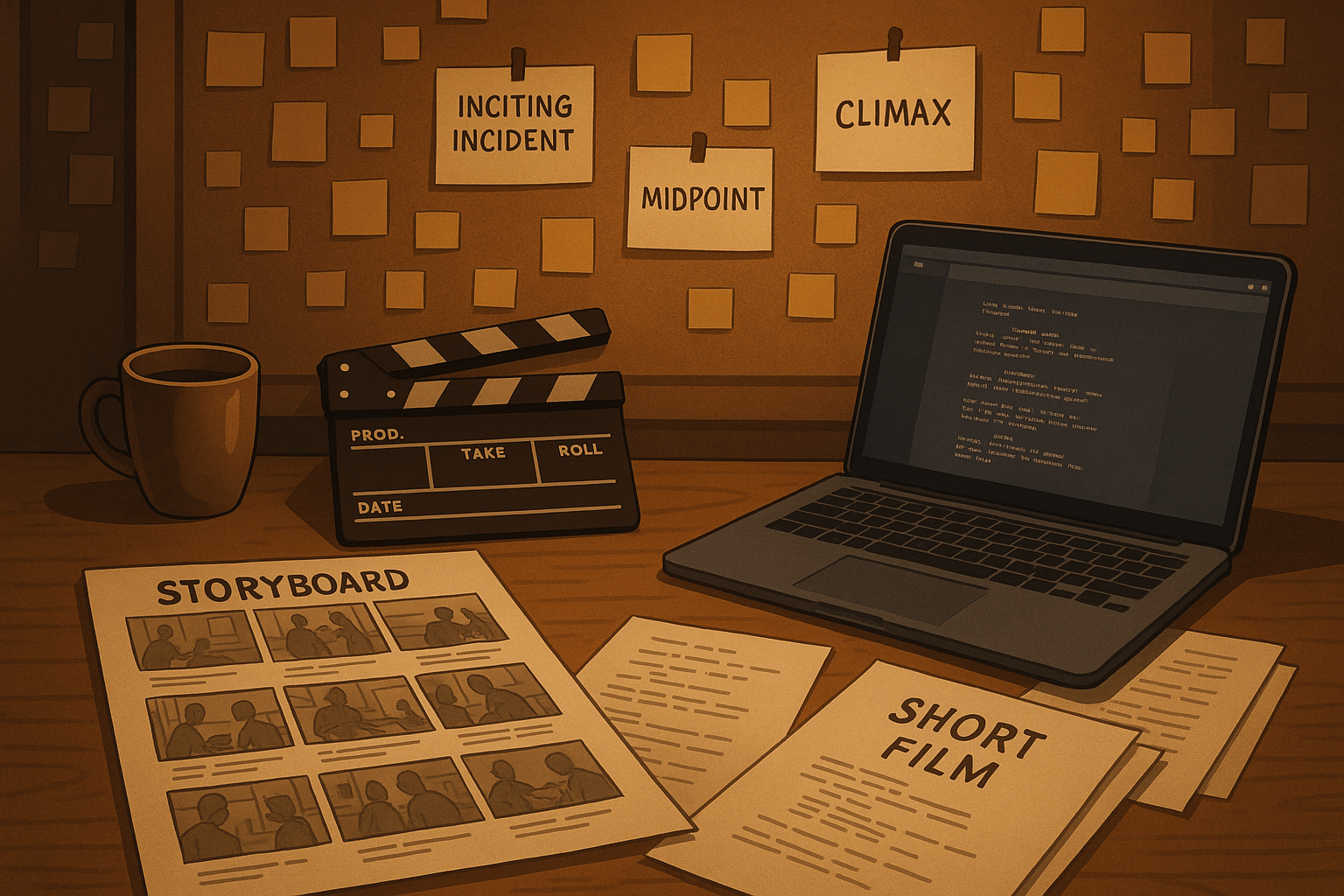
In today’s storytelling landscape, the short film remains one of the most disciplined and rewarding formats a writer can tackle. Whether you’re submitting to festivals, crafting a proof of concept, or simply developing your screenwriting skills, understanding the structure of a short film is essential.
Contrary to popular belief, a short film isn’t just a miniature feature. It’s a self-contained, potent narrative form that demands precision, economy, and vision. Structure is your most powerful storytelling tool. Without it, even the most creative concept can fall flat. But with the right structure, a small story can leave a lasting impression.
Why a Strong Structure Is Essential in Short Films
Time is your biggest limitation—and your greatest creative challenge. In a 3–15 minute film, you must introduce your characters, build tension, explore conflict, and deliver emotional payoff. That’s a tall order in such a tight space.
This is exactly why structure becomes the writer’s best ally. It allows you to hit all the right narrative beats without wasting time. In fact, strong story structure is what gives short films their emotional weight and memorability.
For storytelling guidance and screenplay development, consider learning from professional writers and editors featured in the Best Seller Ghostwriting blog, where practical tips and industry insights are regularly shared.
Identify the Core of Your Story
Find the Emotional Spine
Start with a question: What is this story really about?
Every effective short film hinges on a singular, emotionally resonant idea. It might be a moral choice, a personal discovery, or a turning point in a relationship. This central idea will be the compass that guides your structure.
Avoid complexity for complexity’s sake. Focus on clarity and purpose.
Stay Laser-Focused
Short films don’t have time for subplots. You have one shot—one journey. Ask yourself:
- What moment defines this story?
- How does the protagonist change?
- Can I express this idea without explanation?
Simplicity is key. This doesn’t mean shallow—it means concentrated. Just like a great poem says more with less, a great short film finds power in restraint.
Embrace the Three-Act Structure (In Condensed Form)
Though your runtime is short, the classical three-act format—setup, conflict, resolution—remains the best framework for storytelling.
Act One: Establish the World and the Problem
Right from the first moment, your audience needs answers:
- Who is the main character?
- What’s their world like?
- What tension or need is introduced?
Begin with momentum. Avoid excessive backstory. Instead, drop viewers into a world already in motion. Time is too precious to waste on exposition.
Act Two: Escalate the Conflict
Once you’ve set up the scenario, introduce obstacles. The character must act, and those actions must lead to complications or failures.
In a short film, every moment must matter. Your second act is likely one or two scenes long, so don’t meander. Make each beat a step deeper into the narrative dilemma.
For example, if your film is about someone returning a lost wallet, Act Two might show their search for the owner, only to find it leads to a moral decision or unexpected consequence.
Act Three: Deliver the Resolution
Finally, your story must reach a conclusion that either:
- Resolves the conflict
- Offers a revelation
- Creates emotional closure
The ending doesn’t need to be happy or clean—but it must be meaningful. Viewers should walk away feeling something. The final image or moment should linger in their mind.
Think Visually, Not Verbally
Show, Don’t Tell
Dialogue has its place, but short films are a visual medium first. Ask yourself: Can I show this emotion rather than say it?
- A character holding an empty baby crib tells more than words ever could.
- A long pause before a door opens may say more than a monologue.
Short films flourish when visuals carry emotional weight.
Want to master visual pacing and written format? You might find value in related insights from Best Seller Ghostwriting’s blog writing services, which also touch on clarity, brevity, and emotional tone.
Use Symbolism and Recurring Motifs
Smart short films use visual motifs to deepen meaning. A recurring object—a key, a scar, a clock—can carry narrative significance and help unify the story.
These symbols allow you to convey emotion or theme without added scenes or explanation.
Limit Your Scope—And Use It Intentionally
Keep Locations and Characters Minimal
You don’t need a sprawling cast or multiple sets. In fact, the fewer characters and locations you use, the more focused your story becomes.
- Stick to 1–2 central characters
- Use 1–3 key locations at most
The more confined your setup, the more room you give for character and theme to emerge.
Let Setting Reflect Emotion
A small apartment, a classroom, a gas station—ordinary places become extraordinary when they echo your character’s emotional state. Don’t just choose a location for convenience; choose it for meaning.
Know Your Ending Before You Begin
Reverse-Engineer the Climax
Many great short films begin with a final moment in mind. Whether it’s a visual punch, a twist, or quiet catharsis, having your ending in sight helps shape every decision leading up to it.
Ask yourself:
- What’s the emotional beat I want to end on?
- Does every scene lead us closer to that?
- Is the final image something the viewer will remember?
Avoid Unclear or Unearned Endings
Ambiguity can be powerful, but only when done intentionally. An open ending should feel complete, not confusing.
Structure is your safety net. It allows even a twist or abstract ending to feel grounded.
Use Time Wisely—Every Scene Must Earn Its Place
Compress Without Losing Meaning
Time is your enemy and your canvas. With so little space, every shot, word, and movement must serve the story.
- Does this scene build character?
- Does it push the plot?
- Can it be shorter?
If the answer is no, cut it.
Focus on the Present, Not Backstory
Instead of explaining who your character used to be, show who they are now. Let the audience infer the past through action, silence, or gesture.
Backstory slows things down. Present action keeps your story alive.
Final Thoughts: Structure Is Creative Freedom
Great short films don’t happen by accident. They’re shaped with intention, discipline, and craft. Structure isn’t about rules—it’s about rhythm, flow, and emotional clarity.
Here’s what matters most:
- Know what your story is about—deep down.
- Keep your focus tight.
- Let visuals carry the emotion.
- Write toward a powerful ending.
- Make every second matter.
When you do that, your short film doesn’t feel short—it feels complete.


