

 +1-786-272-2672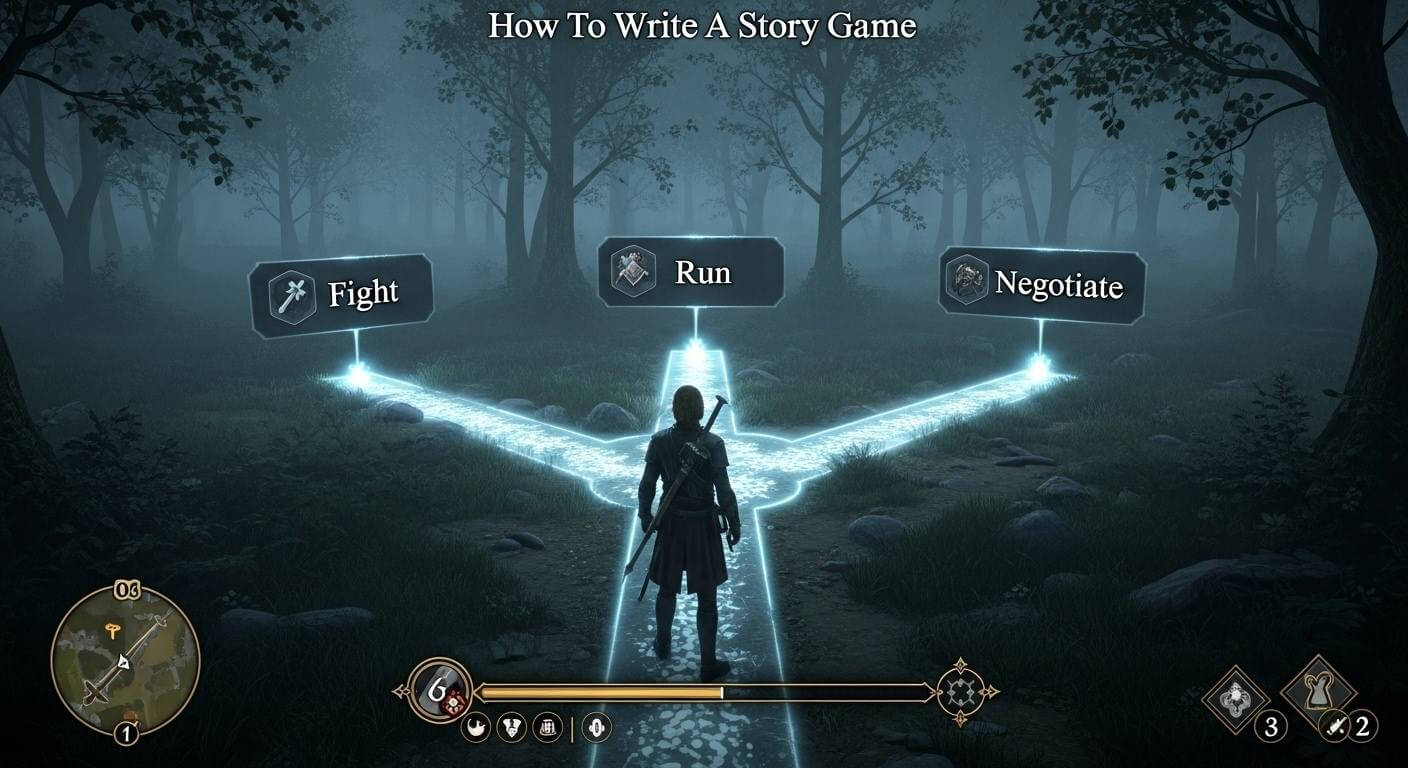
In today’s evolving world of gaming, story games have become one of the most immersive forms of entertainment. They don’t just entertain—they make players feel, think, and choose. Whether you’re drawn to the heart-wrenching dilemmas of Life is Strange or the gritty political stakes in Disco Elysium, these games prove one thing: the best storytelling happens when the player is part of the narrative.
But writing a story game is a different beast than writing a novel or screenplay. Not only do you need a compelling plot, but you also need to design branching narratives, player agency, and dynamic character relationships. So if you’re wondering how to write a story game that actually resonates with players, you’ve landed in the right place.
What is a Story Game, Exactly?
At its core, a story game is a game where the narrative is front and center. Unlike action-heavy games where story takes a backseat to mechanics, story games rely on characters, dialogue, and decisions to move things forward.
These games range from:
- Text-based adventures (e.g., Zork, 80 Days)
- Visual novels (e.g., Doki Doki Literature Club, Ace Attorney)
- Interactive fiction (e.g., Heaven’s Vault)
- RPGs with deep choice mechanics (e.g., Mass Effect, The Witcher 3)
Because of this diversity, learning how to craft a story game opens doors to multiple genres and storytelling styles. So, wanna know how to connect with the right ghostwriter for your genre? Check our blog.
Step 1: Start With a Central Narrative Hook
First and foremost, every great story game starts with a narrative hook—a question or scenario that grabs attention and doesn’t let go. Instead of focusing solely on world-building or game mechanics, think about the emotional stakes.
For Example:
- What if the player could go back in time to prevent a disaster—but only once?
- What happens when a character wakes up in a world where nobody remembers them?
- How would society react if lies were suddenly impossible?
When you have a core hook, everything else—setting, tone, gameplay, and character arcs—will naturally begin to align.
Want help developing a compelling fiction concept? Explore our fiction writing services for expert guidance.
Step 2: Create a World That Feels Real and Reactive
Secondly, unlike linear stories, games demand a world that responds to the player’s decisions. Thus, your setting should be more than just a backdrop—it should feel alive, logical, and consistent.
Ask Yourself:
- What are the rules of this world?
- What kind of conflicts exist between its characters, ideologies, or factions?
- How can environmental storytelling reveal parts of the lore organically?
For instance, in The Last of Us, the world is told not just through cutscenes but through abandoned homes, graffiti, and quiet visual cues. These details allow players to discover the story rather than be spoon-fed exposition.
Need help developing a rich narrative world? Check out our ghostwriting services to bring your universe to life.
Step 3: Design Characters With Motivations Beyond the Player
Moving forward, let’s talk characters. In story games, your characters must be more than walking dialogue boxes—they need motivations, relationships, and growth arcs of their own.
- Your protagonist can either be predefined (like Arthur Morgan in Red Dead Redemption 2) or customizable.
- Secondary characters should react to choices, remember past conversations, and sometimes even oppose the player.
Keep in mind that compelling characters don’t exist to serve the player—they exist to challenge them.
Read our blog on character development through a sheet template to dig deeper into writing multidimensional personalities.
Step 4: Structure a Narrative That Offers Meaningful Choices
Next, remember that a player in a story game isn’t just a spectator—they’re a co-creator of the narrative. Therefore, you must design a plot that branches, loops, or reacts dynamically to input.
Story Structures That Work Well:
- Branching Paths: Every decision leads to a different outcome (Detroit: Become Human).
- Hub-and-Spoke: Central missions with multiple subplots returning to a main story hub (Mass Effect).
- Emergent Narrative: Systems generate stories through interactions (Crusader Kings).
While mapping out your story, consider using tools like Twine, Inkle, or Scrivener to track player paths, character arcs, and narrative flags.
Step 5: Build Choices That Actually Matter
Moreover, player agency only works if the choices actually affect the outcome. Too many games create “illusion of choice” scenarios where dialogue may change, but the result remains the same. Avoid this trap by designing real consequences.
Meaningful Choices Could:
- Impact character relationships.
- Change the world state or gameplay mechanics.
- Unlock or restrict new storylines.
- Alter the emotional tone or perspective of the ending.
Even subtle narrative shifts can leave a lasting emotional impact when handled with care.
Step 6: Dialogue Should Feel Natural—And Impactful
Let’s not forget: dialogue is where your characters live and breathe. It’s where players make their decisions, form relationships, and learn about the world.
Strong Dialogue Is:
- Concise: Trim the fat. Players often skim.
- Interactive: Offer varied tone options—sarcastic, empathetic, logical.
- Reactive: Tailor responses to past decisions or emotional states.
- Pacing-sensitive: Use silence and interruptions strategically.
For games heavy on dialogue, consider implementing timed responses or multi-layered conversations that unlock based on trust or past behavior.
Need expertly crafted conversations? Our ghostwriting services are ideal for visual novels and branching narratives.
Step 7: Weave Story Into Gameplay, Not Just Cutscenes
As we move forward, remember that a story doesn’t only happen in dialogue. Some of the most powerful storytelling happens during gameplay itself.
Consider how Papers, Please transforms repetitive bureaucracy into a moral battleground—or how Celeste uses gameplay difficulty to mirror mental health struggles. These experiences prove that narrative doesn’t need to pause for gameplay. They can walk hand-in-hand.
So, design your mechanics to reflect the emotional state or thematic core of your story.
Step 8: Endings Should Reward the Journey
Let’s be honest—if your ending doesn’t reflect the journey, players feel cheated. Instead of offering a “good” and “bad” binary, write multiple nuanced endings that reward exploration, morality, and key decision points.
A Great Ending Will:
- Reflect accumulated choices.
- Provide emotional or thematic resolution.
- Invite players to replay and explore alternate outcomes.
Whether you offer three endings or thirty, make sure they all speak to the heart of the game’s message.
Step 9: Playtest Ruthlessly, Edit Honestly
Lastly, a story game is never finished after the first draft. It requires intensive iteration. Playtest with diverse groups. Watch their body language. Take notes when they look confused or disengaged.
Ask questions like:
- Did this choice feel meaningful?
- Were you emotionally invested?
- Was anything unclear or abrupt?
Revision is not just a polish—it’s part of the design process. And in story games, clarity and cohesion are everything.
Recommended Tools for Writing Story Games
To streamline your process, here are some helpful tools:
- Twine: Ideal for branching narratives and CYOA formats.
- Inkle/ink: Professional-level narrative scripting used in 80 Days.
- Ren’Py: Great for visual novels and script-based games.
- Scrivener: Perfect for managing long-form branching content.
- Articy Draft: Industry-standard for large narrative teams.
Learn From the Greats
Still unsure how your story should take shape? Then study those who’ve done it best:
- Firewatch – for emotional minimalism.
- Oxenfree – for organic, real-time dialogue.
- The Witcher 3 – for moral ambiguity in branching paths.
- Heaven’s Vault – for language and narrative fusion.
Final Words: Story Games Are About Empathy, Not Just Plot
Ultimately, writing a story game is an act of trust. You’re allowing someone else to step inside your world and change it. That’s what makes interactive fiction such a powerful medium—it’s not just about telling a story, but sharing one.
So, write a world you want players to explore. Craft decisions they’ll agonize over. Let characters surprise them. And above all, build a story that doesn’t just entertain—it stays with them.


